Why getting motivated is never enough — and what the most successful people do instead.
On the last day of every year, people will vow to get off sugar, launch their new business or get really fit. The intention is genuine and there is a surge of excitement and motivation to change. In January, the gyms record a higher number of memberships, but by February, the gyms are quiet again.
This is not about human weakness. This is about a widespread misunderstanding of what actually drives lasting success — and why motivation, for all its electricity, was never meant to carry us all the way to the finish line…
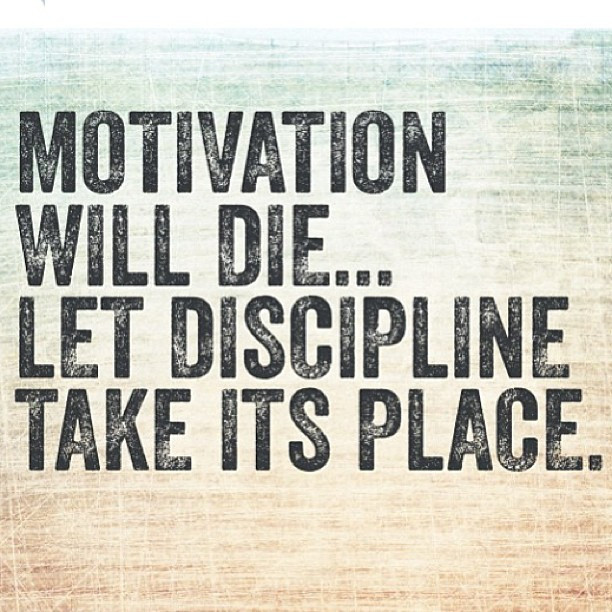
The Seduction of Motivation
Motivation feels empowering because it is empowering — in the short term. It is the spark, the ignition, the thing that makes us get off the couch and say yes, this time will be different. Inspirational quotes get millions of shares. There’s an entire industry built on the Law of Attraction idea that if you can just want something badly enough, the universe will give it to you.
But desiring something is a start, not the whole system. And without a system, even the most compelling desire eventually runs aground. Jim Rohn, one of the most influential personal development philosophers said: “Motivation is what gets you started. Habit is what keeps you going.” He understood well that the emotional fuel that lights the fire is not the same fuel that burns steadily for months and years. Those require something different entirely.
That something is discipline.
What is Discipline Actually?
Discipline is not punishment. It is essentially the commitment to do what needs to be done irrespective of how you feel about doing it right now.
Aristotle put it this way: “We are what we repeatedly do. Excellence, then, is not an act, but a habit.” Discipline is the scaffolding on which excellence is built — day after day, when the motivation has long since faded and no one is cheering you on.
The practical difference between motivation and discipline can be illustrated simply:
Motivation says: “I’ll exercise when I feel like it.” Discipline says: “I exercise 5 days a week at 7 am.“
Motivation is conditional. It’s 31 December or the weather is great. Discipline is unconditional. And that distinction changes everything.
Why New Year’s Resolutions Fail
The failure of New Year’s resolutions is one of the most predictable phenomena in modern life. Research published in the Journal of Clinical Psychology has found that fewer than 10% of people who make resolutions actually keep them. The question is not why people fail to stay motivated — it’s why we ever believed motivation alone would be enough.
Here is what happens, almost universally:
On the night of 31 December, a person makes a resolution. The timing is symbolic, the emotion is high, and the commitment feels rock-solid this time around. For the first few days, they act on it. The novelty provides its own momentum. Then life reasserts itself. Work gets busy. Sleep gets short. One bad day leads to missing the goal, and missing it once makes missing it again feel more acceptable. Within three to four weeks, the resolution is quietly abandoned — not with a bang, but with a sheepish silence.
The resolution failed not because the person lacked a genuine desire. They had plenty. It failed because desire was never paired with a structure or system. There was no plan for the difficult days ahead. No system that operated independently of mood. No discipline.
Jim Rohn framed this with his usual clarity: “Discipline is the bridge between goals and accomplishment.” Without that bridge, even the most spectacular vision remains unfulfilled.
Real Lives, Real Proof – Nelson Mandela’s 27-Year Discipline
In 1964, Nelson Mandela was sentenced by the apartheid regime in South Africa to life imprisonment. He could have allowed the injustice of his situation to consume him. Instead, he created an internal structure of discipline that would sustain him for 27 years.
He exercised every morning — running in place for 45 minutes, doing push-ups and sit-ups — not because he was motivated (no reasonable person could be motivated in a small cell), but because the routine was his act of assertion. He studied, he read, he mentored fellow prisoners, and he refused to let the imprisonment define his identity.
When he emerged in 1990 and ultimately became President of South Africa, it was not because his motivation had never wavered — it had, many times. It was because his discipline had never broken.
The Neuroscience Behind the Gap
Understanding why motivation fades is not just philosophically useful — it’s backed by biology. Motivation is closely tied to dopamine, a neurotransmitter associated with anticipation and reward. The anticipation of a new goal and the associated possible outcome floods the brain with dopamine, which is why the first few days of a new habit feel energizing and almost effortless.
But dopamine is stimulated by novelty, and novelty fades. By week three of the same habit, the brain no longer finds the routine new or exciting. The dopamine surge is gone. The motivation that felt so natural now has to be manufactured — and manufacturing it takes more energy than most people have available after a long and exhausting day at work.
Discipline, by contrast, operates on a different neural pathway: the basal ganglia, which governs automatic behavior and habit formation. When a behavior is repeated consistently enough, it becomes encoded as habit and requires far less conscious effort.
Motivation lives in the pre-frontal cortex. Discipline, over time, gets handed off to autopilot. That is the transition every high performer is trying to make.
The Phenomenon of Consistency
Rohn’s philosophy was, at its heart, a philosophy of consistent small actions. He rejected the idea of transformation through grand gestures and instead taught that every day counts — not because each individual day is dramatic, but because days compound. “Success is nothing more than a few simple disciplines, practised every day,” he wrote. “While failure is simply a few errors in judgement, repeated every day.”
This is worth reflecting on. The gap between success and failure is not talent. It is not resources. It is not luck. It is the discipline to repeat the right actions long after the motivation to do so has gone.
The person who walks every day after dinner for a year will produce results that no amount of New Year motivation could touch. The entrepreneur who writes one page of their business plan every morning for six months will have something real to show at the end. The parent who reads with their child every night — even on the nights when everyone is exhausted — is building something that cannot be measured in a single evening but will be visible across a lifetime.
Building Discipline When Motivation Has Left the Building
The good news is that discipline can be cultivated. It is not a personality trait that some people have and others don’t. It is a skill, and like all skills, it is developed through practice — specifically through the practice of doing the hard thing on the easy days, so that you have the capacity to do it on the hard ones.
A few principles that hold across the research and the lives of consistently successful people:
Lower the activation energy. Make the disciplined action the path of least resistance. If you want to exercise in the mornings, lay out your workout clothes the night before. If you want to write, keep your document open on your desktop. Motivation won’t always be there to push you over the starting line — so shorten the distance to it.
Anchor habits to existing routines. This is called “habit stacking.” For example, after you drink your morning coffee, you write for 20 minutes. Then you sit at your desk to review the day’s priorities. The existing habit becomes the trigger for the new one, removing the need for a fresh decision each time.
Design for failure. Not if, but when you miss a day — because you will — have a pre-decided response. The rule used by many high performers is simple: never miss twice. One missed day is an accident. Two is the beginning of a new habit — the wrong one.
Measure the process, not just the outcome. Track whether you showed up, not just whether you succeeded. This works because it makes the act of showing up the win. The outcome — e.g. weight loss — followed from that, but it was not itself the daily target.
Motivation as a Starting Point, Not a Destination
None of this is an argument against motivation. Motivation is essential. It is the reason you begin, the reason you care, the reason you chose this goal and not some other one.
But motivation is the spark, not the fire. And a spark, however bright, dies in the dark without fuel.
Discipline is the fuel. It is the daily choice to honor the commitment you made on the good day, on the bad day, on the indifferent day when you can’t remember why any of this seemed like a good idea. It is the foundation on which every durable success in human history has been built.
The New Year’s resolution that changes your life will not be the one made with the most emotion. It will be the one paired with a system, a structure, and the unglamorous daily practice of showing up.
Start with motivation. Stay with discipline. That is the real secret.
“We must all suffer one of two things: the pain of discipline or the pain of regret.” — Jim Rohn
Leave a Reply