

MS Data Science & AI provides huge career growth. The data science industry is booming, with job opportunities projected to increase by 36 percent by 2031. As data and technology become integral to various sectors such as healthcare, digital marketing, financial services, technology, retail, media, and telecommunications, the demand for professionals who can manage and interpret this data continues to rise.
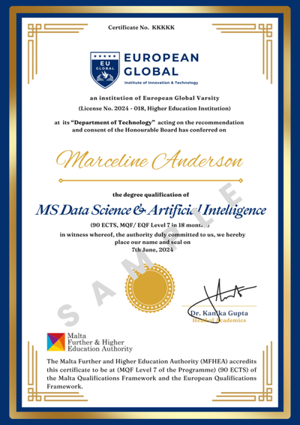
European Global Institute of Innovation & Technology (EU Global) is a fully recognised Higher Education Institution by Malta Further & Higher Education Authority (MFHEA). EU Global was founded with a vision of high-quality, accredited education to global learners, enhancing their employability and global mobility.

The MS Data Science & AI programme is designed and quality assured by doctoral and post-doctoral Professors along with industry experts with huge experience. Learners study 12 modules with all modules assessed using a project-based assignment. There is a Capstone Consulting Project and a Master Thesis towards the end of the programme with an industry mentor.

STUDY MODEL
Online MS, 90 ECTS, assignment-based assessments
ACCREDITATION
Fully accredited by Council for Higher Education Development, USA and Malta Further & Higher Education Authority (MFHEA)
VALUE-ADD
Project based learning
The course focuses on developing statistical thinking to set a foundation of various specialisation courses in their future course of study. It involves introduction to the statistical concepts and tools widely used for Data Analysis and helps in effective decision making. Statistical knowledge develops and extends the conceptual knowledge of students to infer noteworthy results/findings.
Students will be given an opportunity to work through sample data as well as the theoretical principles, tools, and procedures of statistics.
Mathematics for Data Science is a foundational course that provides essential mathematical concepts and techniques required for understanding and analysing data in various fields such as statistics, machine learning, and data analysis. Understanding these mathematical concepts and techniques provides a solid foundation for tackling real-world data science problems and developing effective solutions.
This course comprehensively addresses foundational principles essential for entry into the realm of data analytics, integrating both theoretical frameworks and practical applications. It functions as a foundational stepping stone for individuals seeking to engage with data, catering particularly to novices in the field.
The course allows students to gain an in-depth understanding of programming in Python for data analytics. Students slowly gain pace by creating a variety of basic scripts and gradually pick up advanced features with each of the course modules designed meticulously. The course will allow students to explore the large and multi-faceted Python libraries to solve a wide variety of data analytics and data visualisation problems.
The foundations of good data-driven storytelling will be covered in this course. The skills that students acquire will enable them to convey data findings in visual, oral, and written contexts to a variety of audiences and the public. The associated tools will be introduced to the class. Students learn the abilities needed to be proficient Data Storytellers on this course.
They will learn where to obtain and download datasets, how to mine those databases for information, and how to present their findings in a variety of forms. Through visual data analysis, students will learn how to “connect the dots” in a dataset and identify the narrative thread that both explains what’s happening and draws their audience into a tale about the data. Additionally, students will learn how to convey data stories in various ways to various stakeholders and audiences.
This course widely covers contemporary topics in Artificial Intelligence, primarily – Machine learning. It deeply focuses on the core concepts of supervised and unsupervised learning. Learners will learn the popular Machine Learning algorithms and techniques. The exercises after each unit will extend the applications of machine learning concepts to a range of real-world problems. This course will focus on related topics like machine learning, deep learning and their applications and solutions. Learners shall be able to acquire the ability to design intelligent solutions for various business problems in a variety of domains.
Throughout the course, emphasis will be placed on both theoretical understanding and practical implementation of machine learning algorithms. By the end of the course, students will have gained a solid understanding of the fundamental concepts and techniques of machine learning and will be well-prepared to apply them to real-world problems.
The purpose of this course is to serve as an introduction to machine learning with Python. Learners will explore several clustering, classification, and regression algorithms and see how they can help us perform a variety of machine learning tasks. Then learners will apply what they have learned to generate predictions and perform segmentation on real-world data sets. In particular, learners will structure machine learning models as though they were producing a data product, an actionable model that can be used in larger programs. After this course, learners should understand the basics of machine learning and how to implement machine learning algorithms on your data sets using Python. Specifically, they should understand basic regression, classification, and clustering algorithms and how to fit a model and use it to predict future outcomes.
This course is designed to provide an in-depth understanding of Convolutional Neural Networks (CNNs) and Recurrent Neural Networks (RNNs), two fundamental architectures in the field of deep learning. Participants will gain hands-on experience in designing, implementing, and optimising these neural network types for various applications, including image recognition, natural language processing, and sequential data analysis.
The objectives are to develop understanding of the basic principles and techniques of image processing and image understanding, and to develop skills in the design and implementation of computer vision software.
To introduce students the fundamentals of image formation; To introduce students the major ideas, methods, and techniques of computer vision and pattern recognition; To develop an appreciation for various issues in the design of computer vision and object recognition systems; and To provide the student with programming experience from implementing computer vision and object recognition applications
The area of natural language processing (NLP) is expanding quickly and has broad applications in the humanities, social sciences, and hard sciences. Effective linguistic and textual data management, use, and analysis is a highly in-demand skill for academic research, in government, and in the corporate sector. The goal of this course is to provide a theoretical and methodological introduction to the most popular and successful current approaches, tactics, and toolkits for natural language processing, with a particular emphasis on those created by the Python programming language.
Students will gain extensive experience using Python to conduct textual and linguistic analyses, and by the end of the course, they will have developed their own individual projects, gaining a practical understanding of natural language processing workflows along with specific tools and methods for evaluating the results achieved through NLP-based experiments. In addition to comparing new digital methodologies to traditional approaches to philological analysis, students will gain extensive experience using Python to conduct textual and linguistic analyses.
The broad rise of large information stockpiling needs has driven the birth of databases generally alluded to as NoSQL information bases. This course will investigate the sources of NoSQL information bases and the qualities that recognize them from customary data set administration frameworks. Central ideas of NoSQL information bases will be introduced.
In this course, learners will learn exciting concepts and skills for designing data warehouses and creating data integration workflows. These are fundamental skills for data warehouse developers and administrators. Learners will have hands-on experience for data warehouse design and use open source products for manipulating pivot tables and creating data integration workflows. In the data integration assignment, learners can use either Oracle, MySQL, or PostgreSQL databases. Learner will also gain
conceptual background about maturity models, architectures, multidimensional models, and management practices, providing an organisational perspective about data warehouse development. If a learner wants to become a data warehouse designer or administrator, this course will give accurate knowledge and skills to do that. By the end of the course, learner will have the design experience, software background, and organisational context that prepares you to succeed with data warehouse development projects. In this course, learners will create data warehouse designs and data integration workflows that satisfy the business intelligence needs of organisations.
A research methodology course equips students with the foundational skills and knowledge needed to conduct rigorous and effective research across various disciplines. Through this course, students learn the principles and techniques essential for designing, executing, and interpreting research studies. They delve into topics such as formulating research questions, selecting appropriate data collection methods, understanding sampling techniques, and mastering data analysis methods, both qualitative and quantitative. Moreover, the course covers ethical considerations, emphasising responsible and transparent research practices. Students gain proficiency in constructing research proposals, reviewing existing literature, and presenting findings with clarity and precision.
This course is highly relevant to understand the systematic scientific research writing process. This process helps in putting in perspective all conceptual learning and provides a framework for continuous growth in one’s own work environment.
The Capstone Consulting Project in Data Science and Artificial Intelligence is the culminating experience for students pursuing a specialisation in these fields. This course provides students with the opportunity to apply their knowledge and skills to real-world problems through a hands-on consulting project. Working in teams, students will collaborate with industry partners or organisations to address challenging data science and AI problems.
This course requires submission of Master Thesis.
Boost your portfolio with Project-based learning
EU Global MS Data Science & AI focuses on preparing publishable project based portfolio and career coaching to prepare you for leading Data Science & AI Jobs.
Our students master in-practice Data Science and AI tools such as
Matplotlib, Pandas, NumPy, Scikit-learn, TensorFlow, R, Python etc., and concepts such as Data science and statistical concepts, Programming with Python, SQL, NoSQL, Artificial Intelligence, Machine Learning, Big Data, Natural Language Processing, Deep Learning, Computer Vision.
- 1 to 1 Data Science Mentor
- 12+ mini-projects and a Consulting Project with Thesis
- Research Residency & Patent Conclave
- Industry Networking & Career Coaching
- AWS & Microsoft Industry Certification counselling