

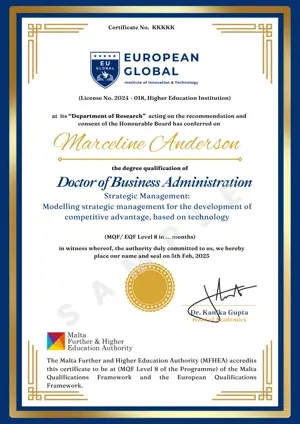
The Doctorate of Business Administration (DBA) is at the highest level of the Malta Qualification Framework (MQF)/ European Qualifications Framework (EQF) Level 8 fully accredited degree programme. This doctorate qualification necessitates the primary focus of the candidate’s work to showcase an original contribution to knowledge within their subject, field, or profession, achieved through original research or the innovative application of existing knowledge or understanding.
European Global Institute of Innovation & Technology (EU Global) is a fully recognised Higher Education Institution by Malta Further & Higher Education Authority (MFHEA). EU Global was founded with a vision of high-quality, accredited education to global learners, enhancing their employability and global mobility.

The modules enable students to evaluate and address a range of business challenges and opportunities using versatile tools applicable across various industries and sectors.


STUDY MODEL
Online DBA, 180 ECTS
ACCREDITATION
Fully accredited by Council for Higher Education Development, USA and Malta Further & Higher Education Authority (MFHEA)
VALUE-ADD
Project based learning
This course, Strategic Leadership and Innovation for Sustainable Development, equips DBA students with advanced knowledge and skills to critically evaluate and shape strategic initiatives within organisations, with a focus on innovative and sustainable managerial decision-making. Students will learn to assess external business influences, evaluate organisational capabilities, and develop strategies that enhance competitive advantage while ensuring sustainable development. The course culminates in the formulation of innovative strategies that contribute to long-term business success and societal well-being.
This module provides students with an opportunity to scholars to develop the capability to make a real difference to organisation performance as a manager / leader, develop and demonstrate a capability for critical and independent learning, develop and demonstrate the capability to apply doctoral learning integratively to the real world.
The Innovation and Entrepreneurship module explores the dynamic role of innovation and entrepreneurship in driving business growth and economic development. The course provides students with a comprehensive understanding of how innovative ideas are developed, transformed into viable business ventures, and managed for long-term success. Emphasis is placed on fostering an entrepreneurial mindset, identifying market opportunities, and understanding the risks and rewards associated with innovation and new venture creation.
The aim of this module is to provide the in-depth exploration of the research methodologies, theories and the philosophical underpinnings related to the research under question and the ways to align the entire research methodology to answer research questions in a manner that provides recommendations also considering business stakeholders acceptability. This module will provide an in-depth exploration of the essential components of research design, which include formulating research questions, constructing hypotheses, identifying research objectives, selecting appropriate methodologies, understanding research types, and determining effective sampling strategies. By building a robust foundation in these core areas, this module equips DBA scholars with the analytical skills and conceptual knowledge required for advanced study in both quantitative and qualitative research methods. This foundational expertise not only prepares scholars to design rigorous, impactful research but also enables them to address complex, real-world business challenges through methodologically sound inquiry in subsequent modules.
The academic publication and rigour is most important for the DBA students. This residency is specifically designed to provide the essential skills and knowledge to the students to navigate the academic publication process. Successfully teaching and learning in this module will let them be aware about the different journals and book chapter publication criteria.
This module on Data Collection and Methods is essential for DBA students as it is an imperative beginning point for the creation of new knowledge and its application to real-world business practices.
The module introduces scholars to various data collection techniques and methods, crucial for designing and conducting empirical research in business administration. It emphasises the importance of gathering reliable and valid data, which serves as the foundation for analysing business problems and informing strategic decisions.
The Data Analysis & Interpretation module is designed for DBA scholars to develop advanced competencies in the analysis and interpretation of data within business contexts. This module emphasises the importance of ethical considerations while engaging with both quantitative and qualitative data. The module covers initial data exploration using descriptive statistics, leading to deeper analysis through selected data analysis techniques.
In this module, DBA scholars will focus on drawing meaningful conclusions by synthesising and critically analysing information and findings from their research to create new knowledge with practical business applications.
Emphasising the importance of ethical considerations, students will learn to report and draft recommendations based on their research outcomes. This module aims to deepen their theoretical understanding while also enhancing their ability to communicate research results effectively in real-world contexts.
This module supports DBA scholars in structuring, writing, and completing their dissertations by integrating research findings with real-world business applications. It emphasises the synthesis of findings, coherence in structuring, and practical implications of research outcomes for business leaders and organisations. Scholars will use the mirroring technique to ensure consistency across dissertation sections, while applying ethical considerations in writing.
Ready for the Doctorate of Philosophy Career!
EU Global academic team also provides opportunities to present in international conferences with participation of reputed Journals such as ABDC, or Scopus listed Journals.
EU Global provides following in addition to the content:
- Research Residency
- Entrepreneurship Residency
- Professional Coaching
- Academic Coaching
- 1:1 Subject specific Supervisors
- Group Research Supervisors
Overall, our team aims to help our scholars to frame their doctoral journey as an asset in your lifelong career.

Generative AI
Research in Generative AI includes AI-driven business transformation, marketing personalization, operational efficiency, and ethical governance. Key areas include AI-powered decision-making, competitive advantage, financial forecasting, HR automation, and industry-specific innovations, etc.

Business & Data Analytics
Research in Business & Data Analytics leveraging data-driven decision-making for strategic growth. Key areas include AI-driven business intelligence, predictive analytics for market trends, customer behavior modeling, financial risk analysis, and operational optimization. Research can explore big data governance, ethical AI, and data-driven competitive advantage in various industries.

Healthcare Management
Research in Healthcare Management can focus on improving hospital operations, patient care quality, and healthcare accessibility. Key areas include leadership in healthcare organizations, the impact of telemedicine, strategies for patient satisfaction, cost management, and policy implementation, etc.

Finance and Investment
Research in Finance and Investment can explore strategies for financial growth, risk management, and sustainable investing. Key areas include corporate financial decision-making, investment trends, wealth management, financial inclusion, and the impact of fintech etc.

HR, Leadership & Psychology
Research in HR, Leadership & Psychology can explore leadership effectiveness, employee motivation, workplace culture, and talent retention. Key areas include emotional intelligence in leadership, the impact of remote work, diversity and inclusion, mental health in organizations, and performance management.

Marketing, E-commerce, and Retail
Research in Marketing, E-commerce, and Retail can explore consumer behavior, omni-channel strategies, digital marketing, personalization, mobile commerce, supply chain optimization, sustainability, customer retention, and the impact of new technologies on shopping experiences and brand loyalty.

Sustainability, Energy, and Environment
Research in Sustainability, Energy, and Environment can explore green energy innovation, sustainable business practices, environmental impact assessment, corporate social responsibility (CSR), renewable energy adoption, eco-friendly supply chains, and the role of businesses in addressing climate change and promoting sustainability.

Operations, Supply Chain & International Business
Research in Operations, Supply Chain & International Business can explore global supply chain optimization, logistics management, cross-border trade strategies, operational efficiency, risk management, outsourcing, the impact of globalization, and how international business practices align with sustainability and innovation in global markets.

Tourism & Hospitality
Research in Tourism & Hospitality can focus on customer experience management, sustainable tourism practices, destination marketing, service quality, tourism trends, technology adoption in hospitality, revenue management strategies, and the impact of global events on travel and tourism industries.