

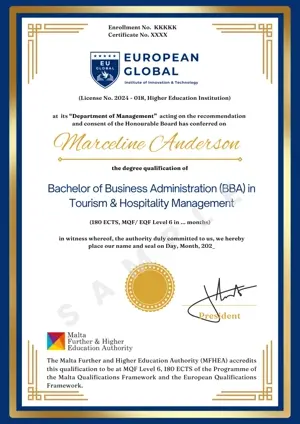
he Bachelor of Arts in Tourism and Hospitality Management provides students with a comprehensive understanding of the tourism and hospitality industries. The program covers key areas such as travel management, event planning, hotel operations, and customer service. Students learn about destination marketing, sustainable tourism practices, and the latest industry trends.
European Global Institute of Innovation & Technology (EU Global) is a fully recognised Higher Education Institution by Malta Further & Higher Education Authority (MFHEA). EU Global was founded with a vision of high-quality, accredited education to global learners, enhancing their employability and global mobility.

The curriculum emphasizes practical experience through internships and real-world projects, equipping students with the skills to manage and innovate in various tourism and hospitality settings. Graduates are prepared for diverse careers in travel agencies, hotel management, event coordination, and tourism development, with a strong foundation for leadership in the industry.
STUDY MODEL
Online BBA, 180 ECTS, assignment-based assessments
ACCREDITATION
Fully accredited by Council for Higher Education Development, USA and Malta Further & Higher Education Authority (MFHEA)
VALUE-ADD
Project based learning
Set the base to learn the best of your MBA!
| Know employability skills & ways to develop it |
| Learn the “Reflective” way |
| How to reach the desired level of outcomes |
| Data Analysis using MS Excel |
| Develop LinkedIn Profile |
| Academic Writing |
The Understanding Business and Management module provides a foundational exploration of what constitutes a business, the different types of business organisations, and key management concepts. It equips learners with a comprehensive understanding of how businesses operate within broader societal, environmental, and ethical contexts. The module also covers essential business functions, external environmental factors, organisational structure and culture, and the strategic role of SWOT analysis in business decision-making.
The Accounting for Business module is designed to provide learners with a comprehensive understanding of accounting and finance concepts within a business context. This module introduces students to the principles and practices of financial accounting, focusing on the preparation, analysis, and interpretation of financial statements. Students will learn about the key legal forms of business, the regulatory environment of the accounting profession, and the needs of financial stakeholders. Additionally, the module covers essential tools and techniques for assessing financial performance and planning.
This module aims to provide learners with a comprehensive understanding of the economic systems, financial markets, and their impact on global business. This course delves into essential economic concepts such as supply and demand, fiscal and monetary policies, market structures, and government-business relations. Learners will also explore different economic systems and their effects on global business operations. Through real-world case studies, students will develop the analytical and critical thinking skills necessary to navigate complex global business environments.
This module provides learners with a comprehensive understanding of Human Resource Management (HRM), focusing on the evolving role of HR in business strategy and operations. It covers the fundamentals of staffing, employee compensation, talent management, and workforce planning. The module explores how HR strategies align with overall business goals, along with emerging trends such as technology’s impact on recruitment, performance management, and employee engagement. Students will also examine employment law compliance, diversity and inclusion practices, and the strategic role of HR in organisational development. Practical case studies and real-world applications will be used to build essential skills in HR forecasting, talent development, and employee engagement.
In today’s data-driven world, effective business decision-making relies heavily on the ability to gather, analyse, and interpret data. This module, Data Insights for Business Decisions, equips learners with the knowledge and skills needed to leverage data for strategic decision-making. The course introduces fundamental concepts of data analytics, data management, and the use of statistical tools and technologies to extract valuable insights from business data.
Students will learn how to apply data analysis techniques to solve real-world business problems and enhance operational, financial, and marketing decisions. Emphasis will be placed on understanding the role of data in shaping business strategies, optimising performance, and driving innovation. The module also covers ethical considerations in data usage, data visualisation techniques, and effective communication of insights to stakeholders.
This course is a language and content integrated module. Students develop the language they use in achieving the objectives above and develop a deeper understanding of topics, concepts, and theories that they will study and use throughout the qualification. The qualification will provide students with:
A thorough understanding of the theoretical and work-based knowledge relevant to the application of business management in theory and practice.
The ability to reflect on experience of business management practices to produce and apply new understanding and skills.
The Innovation and Entrepreneurship module explores the dynamic role of innovation and entrepreneurship in driving business growth and economic development. The course provides students with a comprehensive understanding of how innovative ideas are developed, transformed into viable business ventures, and managed for long-term success. Emphasis is placed on fostering an entrepreneurial mindset, identifying market opportunities, and understanding the risks and rewards associated with innovation and new venture creation.
The Operations and Service Management module is designed to equip students with the knowledge and skills required to manage and improve the operations and service delivery within organisations. This module provides an in-depth understanding of the principles, processes, and strategies involved in the production of goods and the delivery of services. Emphasis is placed on the integration of operations with other business functions, process optimisation, quality management, and the role of technology in enhancing service efficiency.
The course will help the learners to understand about the terms and transactions of accounting and its procedures. How the income generated should be and could be managed in an effective and efficient manner at an organisational level as well as personal level. The learners would be able to understand how to make the accounts and the financial statements, and its calculations through different modes and methods. The course would also help to know the latest developments and the achievements around the world. Due to immense competition prevailing in today’s time, it is important to know the current situations and its need to survive the financials of the firm.
This module provides an in-depth introduction to the tourism and hospitality industry, exploring its historical context, key developments, and contemporary challenges. It covers the foundational concepts of tourism, such as inbound, outbound, and domestic tourism, and examines the influence of technological, economic, and social advancements on the industry’s growth. Students will gain an understanding of the various types of businesses within the sector, including accommodation, restaurants, transport, and travel agencies, and learn about the organisational structure, regulatory requirements, and key governing bodies. Additionally, the module addresses the role and importance of Destination Management Organisations (DMOs) in managing tourism destinations, ensuring sustainability, competitiveness, and cooperation. Through an analysis of current trends and issues, students will develop the knowledge and skills necessary to manage tourism and hospitality operations effectively in a global context.
This module offers an in-depth exploration of sustainability in the tourism and hospitality industry. It begins with a review of the history of sustainable development, followed by a discussion of the United Nations Sustainable Development Goals (SDGs) and relevant policies. Students will gain a solid understanding of the environmental, social, and economic impacts of tourism and hospitality on various types of destinations, including urban, coastal, island, and rural areas. The course examines sustainable tourism principles, policies, and best practices, highlighting their relationship to sustainable development. Key topics include the principles of destination management, corporate social responsibility (CSR), and various sustainability initiatives. The module also covers frameworks for measuring the success of sustainability initiatives, offering practical insights into how tourism and hospitality businesses can implement and monitor sustainable practices.
This module aims to provide students with a comprehensive understanding of the importance of sustainability, quality management, and ethical practices in driving long-term business success. In the context of globalisation and rapidly changing business environments, this module addresses how transnational practices, corporate social responsibility, and quality management principles contribute to building a sustainable and ethical business landscape.
Making Sense of Strategy, is a course which looks at the world of business strategy, of how organisations analyse their external environments and make strategic choices as to where and how to position themselves in relation to their customers and competitors. The course begins with an introduction to strategy looking at what the course means by the word strategy and at its historical antecedents. Block Two, Perspectives on Strategy, further develops these themes and looks at how the “rational” perspective achieved and maintained its prime position. Block Three, The Strategy Toolkit, then moves on to look at the ways the external environment is analysed from within this perspective and at the choices that emanate from such analyses for the organisation. Block Four is a case study in which students collaborate in the virtual environment to analyse, applying some of the tools in the toolkit. Block Five, entitled Implementation, then looks at the thorny issue of how strategies are implemented and the constraints that surround such implementation. The final Block, Where next for Strategy?, goes on to look at some ways of trying to understand strategy that are different from the “rational” perspective.
The Events Management module explores the principles and practices of managing events, with a particular focus on the relationship between the events sector and the tourism and hospitality industries. Students will learn about the classification and characteristics of different types of events, including meetings, incentives, conferences, exhibitions (MICE), and hospitality events such as weddings and corporate dinners. The course provides insights into the selection of event venues, such as hotels and conference centres, and explores the benefits of event management for businesses, including brand exposure, customer engagement, and revenue generation. Additionally, the module delves into the impact of global crises—such as pandemics, terrorism, and economic or political upheavals—on the MICE sector, and addresses the importance of sustainability in event management.
The module explores the key legal frameworks, policies, and planning processes that shape the tourism industry at local, national, and international levels. It provides students with an understanding of how public policy influences tourism development, management, and sustainability. The course delves into the complexities of tourism policy-making, the roles of various stakeholders, and the implementation of tourism policies. Students will analyze the relationship between tourism and other areas of public policy, such as environmental conservation, cultural preservation, and economic development. Through practical case studies and theoretical insights, students will gain skills in developing destination management plans and understanding tourism’s impact on sustainable development.
The aim of this module is to explore the role of emerging and existing technologies in shaping the tourism and hospitality sectors. It provides an understanding of how technological advancements have revolutionized consumer behavior, business operations, and competitive dynamics in the industry. Students will learn about the evolution of technology in tourism, from traditional systems like Global Distribution Systems (GDS) to modern innovations like virtual visitor guides and metaverse platforms. The course also focuses on the role of Information and Communication Technology (ICT), mobile and wireless systems, online travel agencies (OTAs), and cutting-edge immersive technologies such as Extended Reality (XR), Augmented Reality (AR), and Virtual Reality (VR). Through practical examples, students will examine the impact of online marketing, social media, and data protection on enhancing customer experience and gaining a competitive advantage.
Boost your portfolio with Evidence-based Learning
EU Global unique teaching Andragogy of evidence-based management allows learners to practice, recommend and reflect for continuous growth.
EU Global provides following in addition to the content:
- Research Residency
- Entrepreneurship Residency
- Professional Coaching
- Academic Coaching
- 1:1 Project Mentor
Make the best of your Business Studies!