

EU Global MBA in Strategic Human Resource Management (SHRM) is increasingly relevant in today’s dynamic business landscape, where organisations emphasise aligning HR functions with long-term corporate goals. Research shows that companies with strategic HR management practices see a 21% higher profitability and 17% greater employee productivity than those without them.
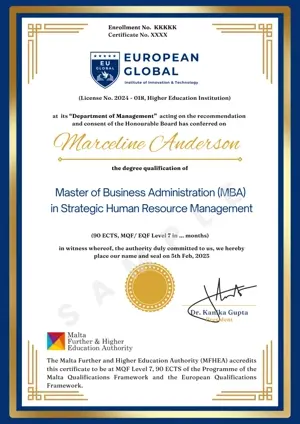
European Global Institute of Innovation & Technology (EU Global) is a fully recognised Higher Education Institution by Malta Further & Higher Education Authority (MFHEA). EU Global was founded with a vision of high-quality, accredited education to global learners, enhancing their employability and global mobility.

STUDY MODEL
Online MBA, 90 ECTS, assignment-based assessments
ACCREDITATION
Fully accredited by Council for Higher Education Development, USA and Malta Further & Higher Education Authority (MFHEA)
VALUE-ADD
Project based learning
Set the base to learn the best of your MBA!
| Know employability skills & ways to develop it |
| Learn the “Reflective” way |
| How to reach the desired level of outcomes |
| Data Analysis using MS Excel |
| Develop LinkedIn Profile |
| Academic Writing |
This module provides an in-depth exploration of management practices and the complexities of organizational dynamics in contemporary business environments. It emphasizes the role of management in shaping organizational behaviour, culture, and effectiveness. Through a combination of theoretical frameworks and practical applications, students will gain a comprehensive understanding of how to navigate and influence the internal and external forces that impact organizations.
This MBA module is intended to examine the theory and current practice of financial reporting, managerial and cost accounting, analysis, and valuation in organizations of various sizes and ranges. Students will get exposure to develop a framework for the use of accounting theory, practice, and tools in the management and leadership of organizations. This will also enable them to apply financial standards and ratios to financial statements and reports for a selection of for-profit, non-profit, and public organizations.
This module focusses on professional development that requires students’ active engagement with a wide variety of materials, activities, and resources to interpret financial data for the purpose of constructing risk assessment, valuation, forecasting activities, and reporting financial results. It will also acquaint them with the preparation of financial statements and understanding of accounting reports.
In today’s rapidly evolving digital landscape, businesses must adapt their marketing strategies to effectively engage with consumers and drive growth. The Strategic and Digital Marketing module equips MBA students with the knowledge and skills required to navigate the complexities of digital marketing and leverage technology to achieve competitive advantage. This module offers a comprehensive exploration of digital marketing strategies, tools, and best practices, with a focus on strategic decision-making and management in the digital era. The module emphasizes the integration of digital marketing with overall business strategy, exploring how data-driven insights can inform marketing decisions, enhance customer engagement, and drive organizational performance.
Project and Operations Management is a critical area of business that focuses on the efficient and effective management of processes and projects to achieve organizational goals. This MBA module is designed to equip students with a deep understanding of the principles, tools, and techniques essential for managing projects and operations in various industries.
The module covers key topics such as project management methodologies, operations strategy, process optimization, quality management, and supply chain management. Students will learn how to plan, execute, and control projects, ensuring they are completed on time, within scope, and on budget. Additionally, the module delves into the management of operations, emphasizing the importance of aligning operational capabilities with strategic objectives to enhance productivity, quality, and customer satisfaction.
This MBA module is intended to give students exposure to finance problems that are prevalent within organizations at the board level. It will equip students to work with finance and accounting experts in the industry confidently. By the end of this module, students will have a grasp of the fundamentals of financial analysis and corporate financial theory. They will understand how to tackle the main financial problems that they are likely to encounter in their job. The financial issues discussed will be those relevant in the private and public sectors and also in the context of a global perspective.
This MBA module is intended to give students exposure to organizational strategies that involve many activities, and therefore, managers should pursue a chosen strategy with consistency and commitment. Students will get to learn the challenges posed by their organization’s environment and see how they can best identify and exploit their organization’s potential sources of advantage. They will equipped with organizational resources and capabilities and the way it competes for scarce resources and customers for its products or services.
This module on The Dynamics of Strategy will be the fifth compulsory stage of the MBA programme providing students with a comprehensive knowledge of real-life examples and case study situations, and to reflect on and challenge their understanding of strategy
This module is designed to equip MBA students with the economic principles and analytical tools necessary for making informed business decisions. By integrating microeconomic and macroeconomic concepts, students will learn to analyse market dynamics, evaluate the impact of economic policies, and apply economic reasoning to real-world business challenges. The module emphasizes practical decision-making skills, enabling students to interpret economic data, assess risks, and formulate strategies that enhance organizational performance in a global economic environment.
This module provides an in-depth exploration of the principles and practices of ethical leadership and governance in the context of contemporary business environments. It examines the moral responsibilities of leaders and the governance frameworks that support ethical decision-making within organizations. The module emphasizes the development of ethical leadership qualities, critical thinking, and the application of governance standards in complex and dynamic business situations. Through case studies, theoretical insights, and practical applications, students will gain a comprehensive understanding of how to lead with integrity and ensure good governance in their organizations.
This module offers a comprehensive examination of corporate sustainability, integrating it with leadership practices essential for driving sustainable business strategies. It explores the intersection of environmental stewardship, social responsibility, and economic performance, emphasizing the role of leadership in fostering a culture of sustainability within organizations. Students will engage with theories, models, and real-world cases to understand how effective leadership can contribute to sustainable development goals, ensuring long-term business success while addressing global challenges such as climate change, resource scarcity, and social equity.
In the present technologically fluid & globalised business environment, effective self-expression is the key to personal success and effective communications are the cornerstone of organisational success. This module develops the soft skills that are needed for both. It is designed as an advanced university level module. It combines state-of-the-art theory with celebrated case studies of their practical applications.
Effective communication is a critical component of leadership, collaboration, and strategic decision-making. This module emphasizes the development of oral, written, and interpersonal communication skills tailored to various business contexts. Students will learn how to craft persuasive messages, manage cross-cultural communications, and utilize digital tools to enhance business communication. By the end of the module, students will be equipped to communicate with clarity, confidence, and impact, ensuring their success in leadership roles and collaborative environments.
The goal of this module is to enhance learners’ comprehension of current issues related to employee engagement, organisational learning, and people management and development. Students will explore and critically assess the aims and objectives of human resource management, focusing on the design and implementation of HR strategies to boost employee engagement and improve organizational performance. This includes analysing the effectiveness of HR action plans and understanding their impact on fostering a motivated and high-performing workforce. Through this unit, learners will develop the skills necessary to contribute to strategic HR initiatives that align with organisational goals.
This module is designed to enhance learners’ strategic leadership and management knowledge and skills. Students will explore how leadership and management contribute to improving teamwork, communication, and overall organisational performance. The course focuses on the roles and competencies essential for strategic-level positions, emphasizing critical thinking and decision-making abilities necessary for effective leadership. Through case studies and practical applications, learners will develop a deep understanding of the strategic impact leaders have on fostering a collaborative and high-performing organisational culture.
The Global Resourcing, Talent, and Reward Management course is designed to provide MBA students with a comprehensive understanding of the fundamental principles and advanced practices in global talent management. This module explores the multifaceted domains of resourcing, talent acquisition, and reward systems within corporate settings, emphasizing the strategic alignment of these processes with global business objectives.
Students will delve into the core aspects of recruitment and selection, examining contemporary strategies for attracting and retaining top talent across diverse international markets. The course will cover effective methodologies for managing employee performance and implementing reward systems that are both equitable and motivational on a global scale. Emphasis will be placed on understanding the theoretical underpinnings and practical applications of these concepts in a multinational context.
This course aims to enhance learners’ comprehension of the fundamental principles governing the management of employment relations. Students will explore the intricacies of employee relations and employment law, emphasizing their purpose and application. A particular focus will be placed on the legislation surrounding recruitment and selection, as well as the employment protections available across various organizational contexts. This unit will equip learners with the knowledge to navigate and apply legal frameworks effectively, ensuring compliance and fostering positive workplace relations.
This module provides MBA students with the critical skills and knowledge to drive innovation and apply design thinking in entrepreneurial ventures. Students will explore the principles of innovation management, the processes involved in bringing new ideas to market, and the strategic use of design thinking to solve complex business problems. The module integrates theory with practical applications, enabling students to cultivate a mindset for creativity, experimentation, and customer-centric design. By the end of the module, students will be equipped to lead innovation initiatives and create sustainable value in entrepreneurial contexts.
This module provides MBA students with the foundational skills and knowledge needed to conduct rigorous and effective research across various disciplines. Through this module, students learn the principles and techniques essential for designing, executing, and interpreting research studies. They delve into topics such as formulating research questions, selecting appropriate data collection methods, understanding sampling techniques, and mastering data analysis methods, both qualitative and quantitative. Moreover, the module covers ethical considerations, emphasising responsible and transparent research practices. Students gain proficiency in constructing research proposals, reviewing existing literature, and presenting findings with clarity and precision.
The Capstone Consulting Project is a culminating experience in the MBA program, designed to integrate and apply the knowledge and skills acquired throughout the module of study. Students will work in teams or individually to address real-world business challenges presented by partnering organizations. This project offers an opportunity to engage in a comprehensive consulting assignment, providing strategic recommendations and actionable solutions to complex business problems. The module emphasizes critical thinking, problem-solving, collaboration, and professional communication. Through this hands-on experience, students will demonstrate their ability to deliver value to organizations while refining their consulting and leadership skills.
If this programme is offered in on-campus mode, this can be taken along with internship.
Boost your portfolio with Evidence-based Learning
EU Global unique teaching Andragogy of evidence-based management allows learners to practice, recommend and reflect for continuous growth.
EU Global provides following in addition to the content:
- Research Residency
- Entrepreneurship Residency
- Professional Coaching
- Academic Coaching
- 1:1 Project Mentor
Make the best of your MBA!